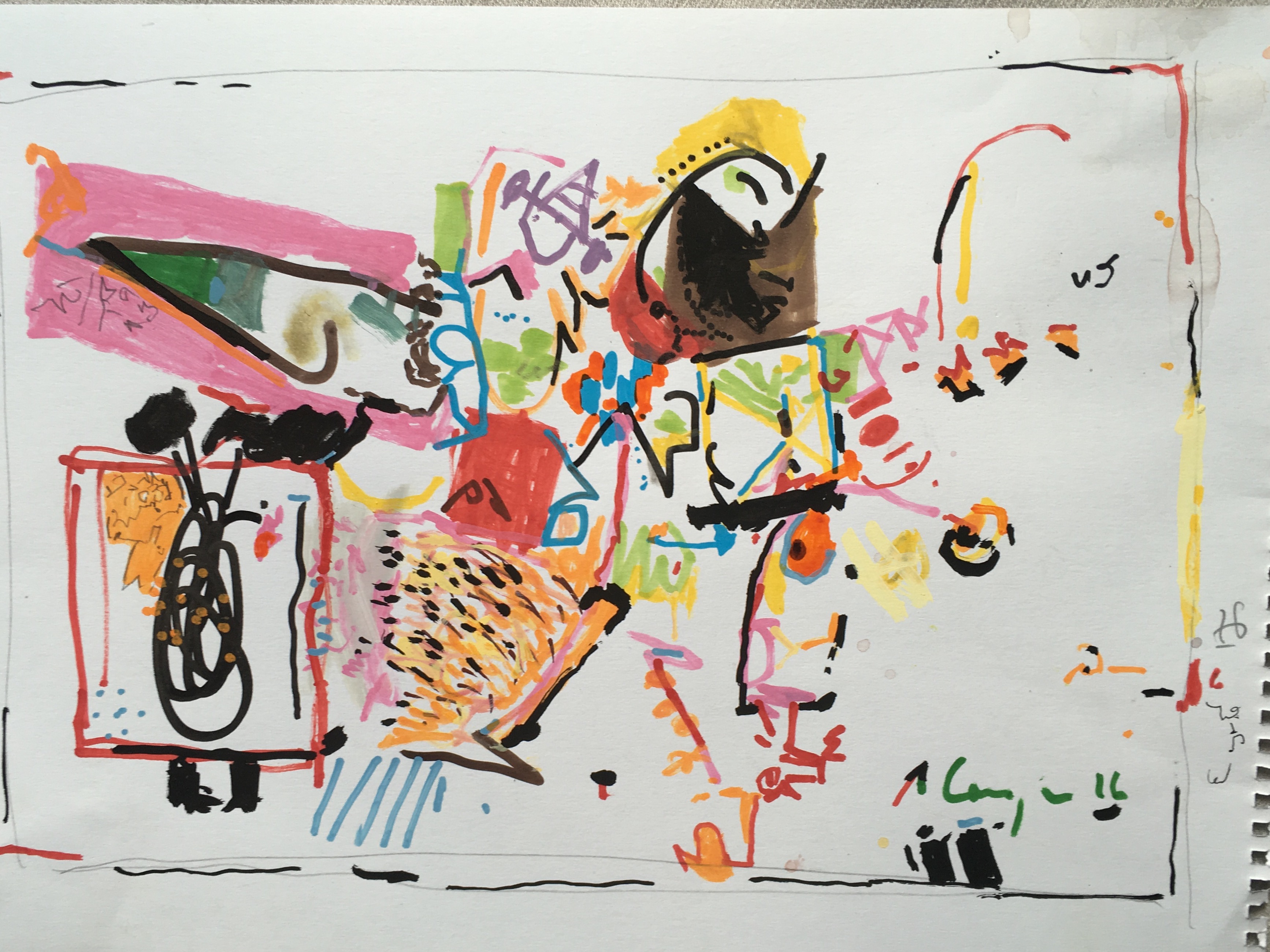
Everybody has experienced it. You are liberating a just purchased electric device from its futuristic styrofoam packing. Hey, doesn’t that look like a sofa? I wrapped a piece in a ragged colour lobe;after a few cuts in packing paper a little man came out and occupied the sofa. Some final pen strokes and he looked quite happy. Millions of these intuitive actions never became art, isn’t that a shame?
The invention of central perspective in the 15th century Italy was not only a progress in design , but also for urbanism, science, visual perception, imagination, sociology, philosophy and even church. People began to realize that the creation of god followed rules to be scientifically researched.
Leon Battista Alberti (1404- 1472) compared pictures with windows. Whatever we view through a window seems to be well ordered. It is amazing but what the following centuries researched and discovered could not completely change our vision and imagination. Canvas and screen are still automatically imagined rectangular.
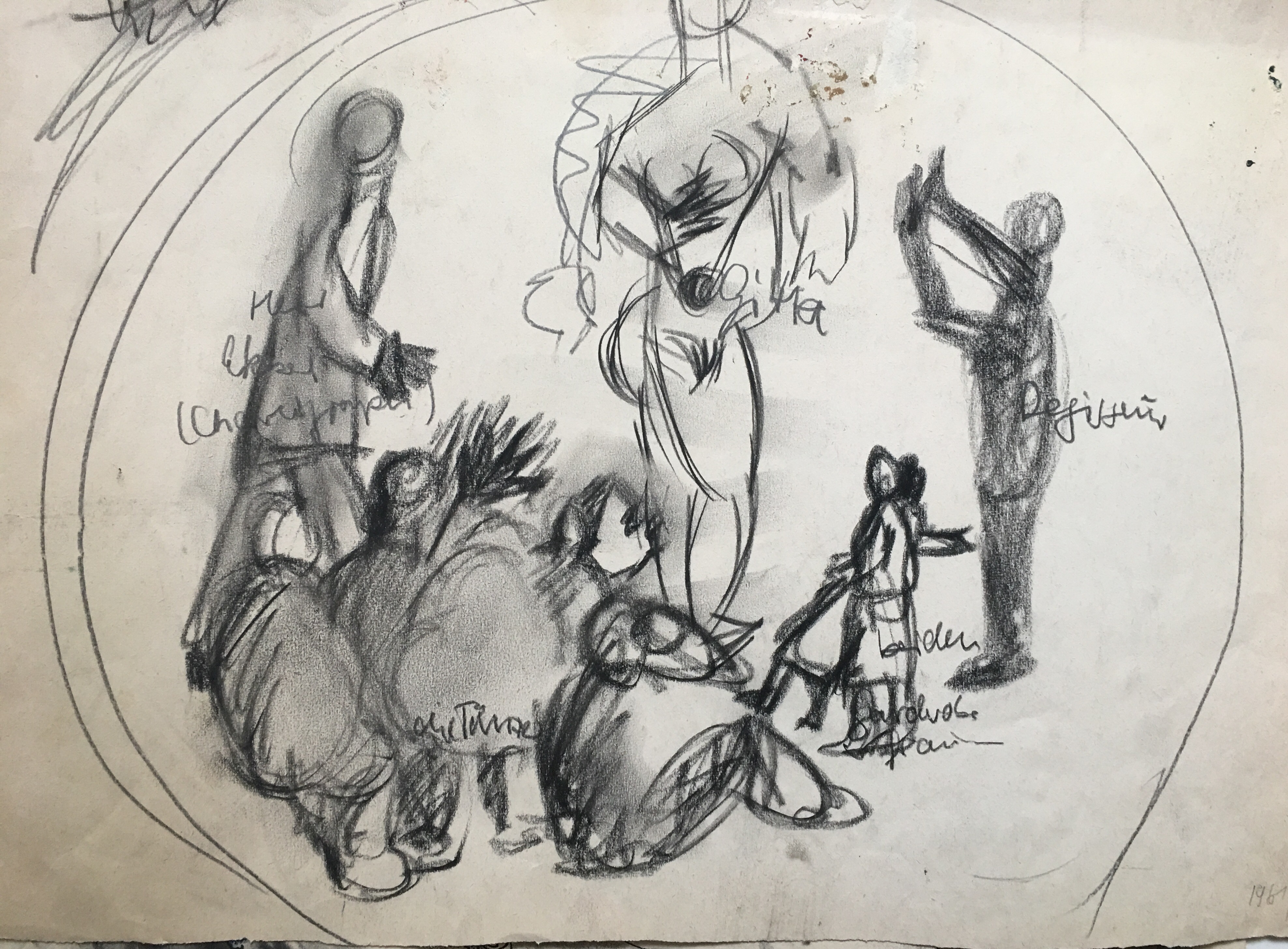
For me personally very soon the concept of a stage became predominant. In and on an imagined stage everything had to happen. That is nothing else but an extended windows concept. In the fine art school I used a carton box as stage, crumpeld waste paper for figures and designed this arrangement.
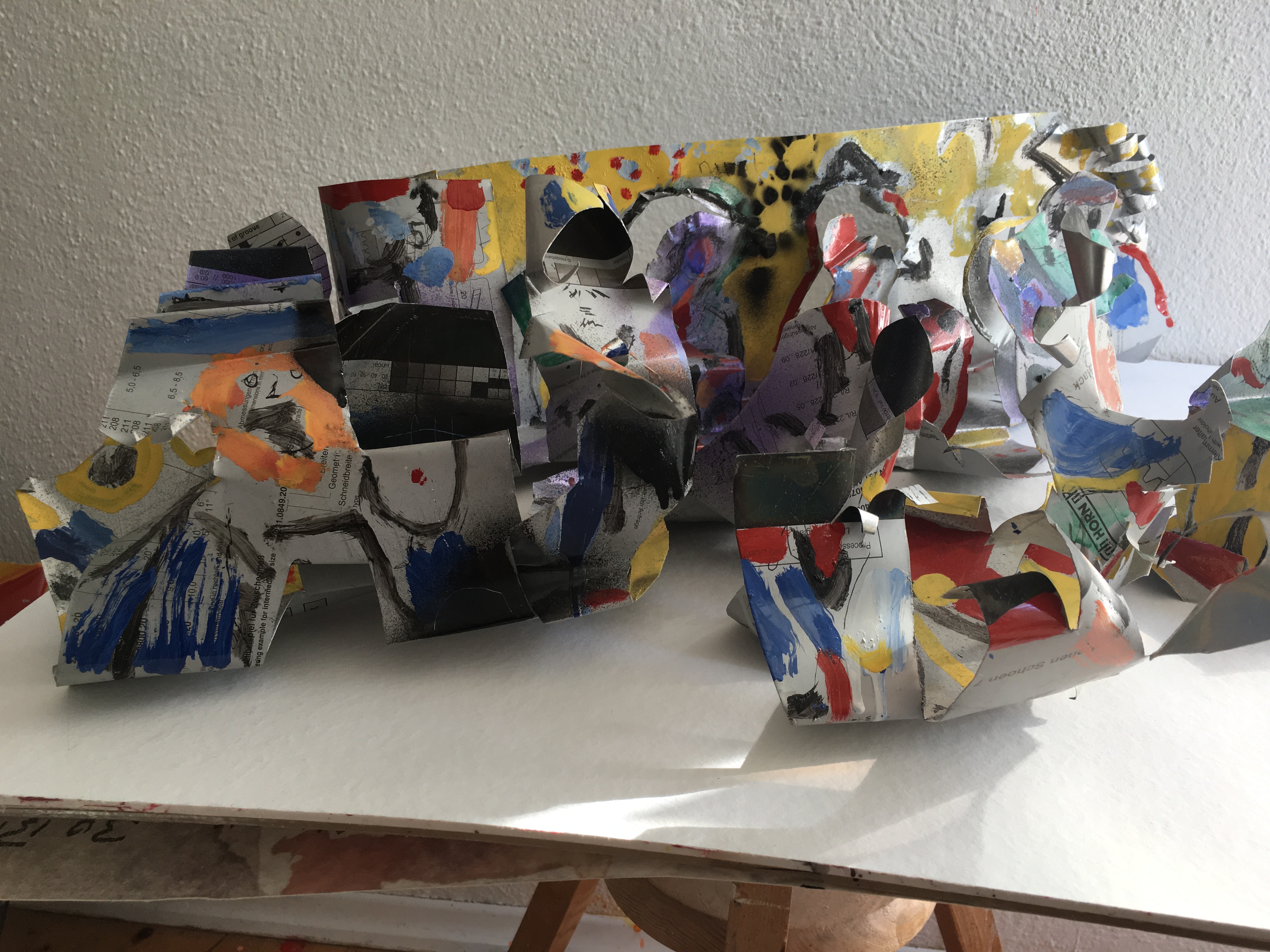
35 years later I modelled figures and furniture in white clay, coloured them and arranged them on a wooden stage. Much easier is it to cut out photos and designs and paste them on cardboard. A real challenge for our imagination is it to cut, fold a whole stage, including persons and props, from a single sheet of thin aluminium and colour it then.
From time to time I remember the professional advice at school. Checking my grades, -acceptable in language and art, horrible in science and math-, the oracle pronounced that I had to be a stage or film director. Later as a student I dragged camera -cabels in a tv studio. The hysterical pseudo-glamour was dissuasive. The biggest advantage I took from this experience was my wife, who worked there as a production assistant.Assisting a tv production (1962)
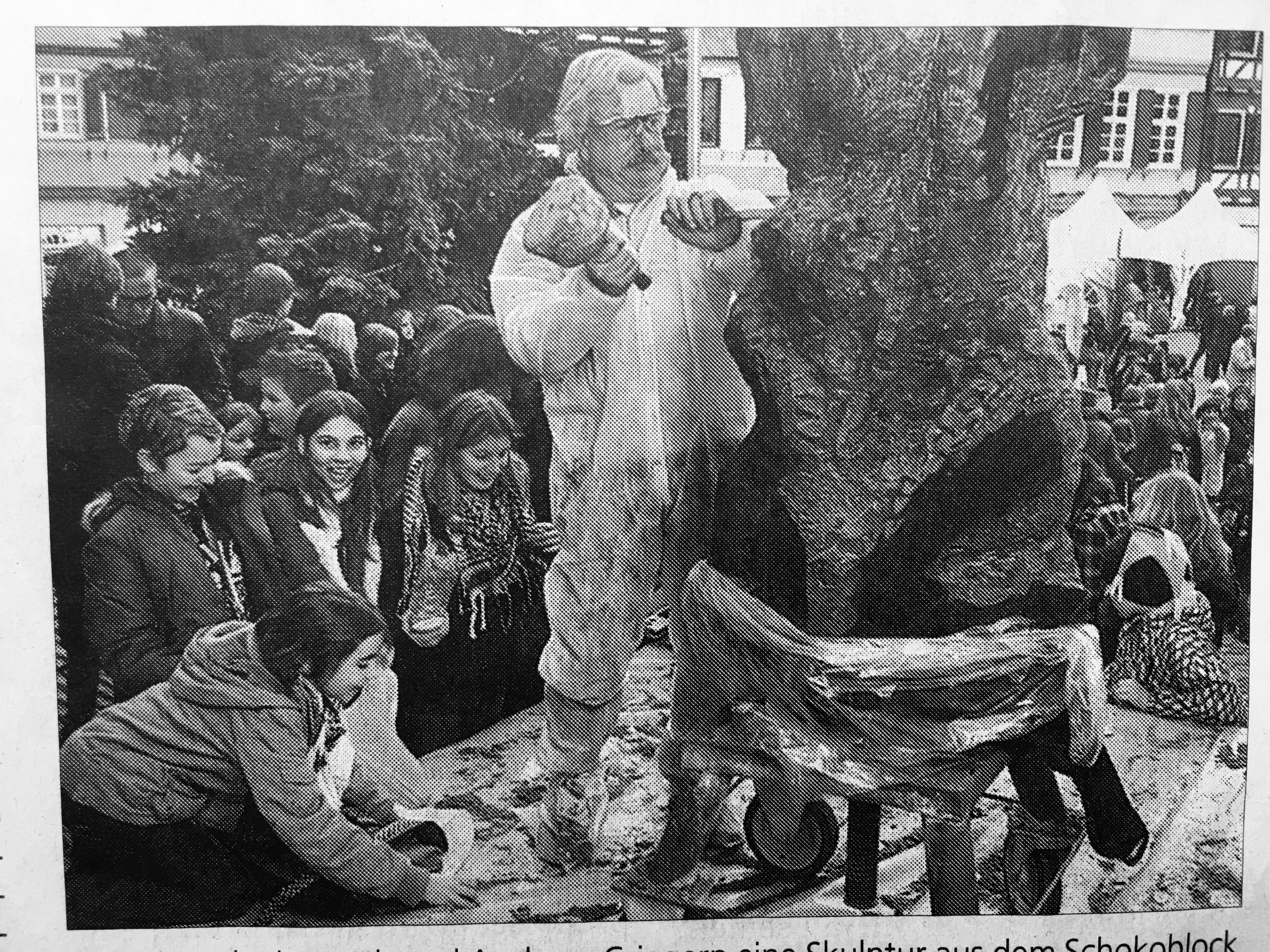
I love chocolate and there are only few days without this sweet friend. So the day before we had invited a friend for dinner and he brought two bars of very tasty chocolate with him. In that moment I remembered an odd experience with chocolate a couple of years ago. After almost nine years I still feel not quite well. The actual migration of scared, prosecuted, starved people may increase my doubts: was it good to perform an artwork of pure chocolate on a public place ? What had happened eight years ago? The local trade association had taken over a concept of a chocolate festival already successfully realized in some cities as Perugia and Torino. And there they had learned that public chocolate sculpturing is attractive and appreciated. Since I hang on the idea of art serving people I accepted a corresponding proposal. A neat block of 400kg dark chocolate (60%) was donated and carried with a crane to a wooden working platform on the marketplace. Before that I had practiced cutting chocolate bars and modelling a cute little chocolate- venus. It was december and pretty chilly,so at least the chocolate didn’t melt, but chunks and shatters were flying around. Everybody was invited to pick them up and take them home. I must say that working with the chocolate block under this circumstances was exciting. The whole thing was for the organizers a success. But not the same way for me. Even some close friends responded very reservedly. In a „green“ city I could have had expected something like this, but anyhow it was disturbing. They didn’t discuss, they seemed to be simply disgusted.Obviously I had hurt ethic principles much more than I had expected. Maybe there was also a quite different point: How can a serious artist degrade art and prostitute himself in this way!? Consequences ? Evaluate careful before engaging in art events -even with the perspective of paddling in a chocolate-pool.
There are two major ways to deal with objects: either contemplating or acting. As an artist I suffer from a drive to move things, change their look, to copy and transform them in diffferent materials with various techniques, to deconstruct and analyze them. I remember the very first meeting of our illustration class some fifty years ago. We had to choose one of the objects being around and draw it. I didn’t really like this job. I decidet to take Photos of an antique head. I worked in black and white from any possible angle and in various lightings trying hard to bring this white mass to life, to animate it. The word Animation from the latin ‚anima‘, soul, matches this passion perfectly, because it comes deep from my heart and soul.
Joining students drawing nudes one day, I took a handfull white clay and modelled the young lady instead of drawing her. Later I painted the little statue with watercolour. That gave the 5-minutes study an erotic touch.
But we are not only actors and performers-we are also victims: just think about sex appeal and its animating effect!!
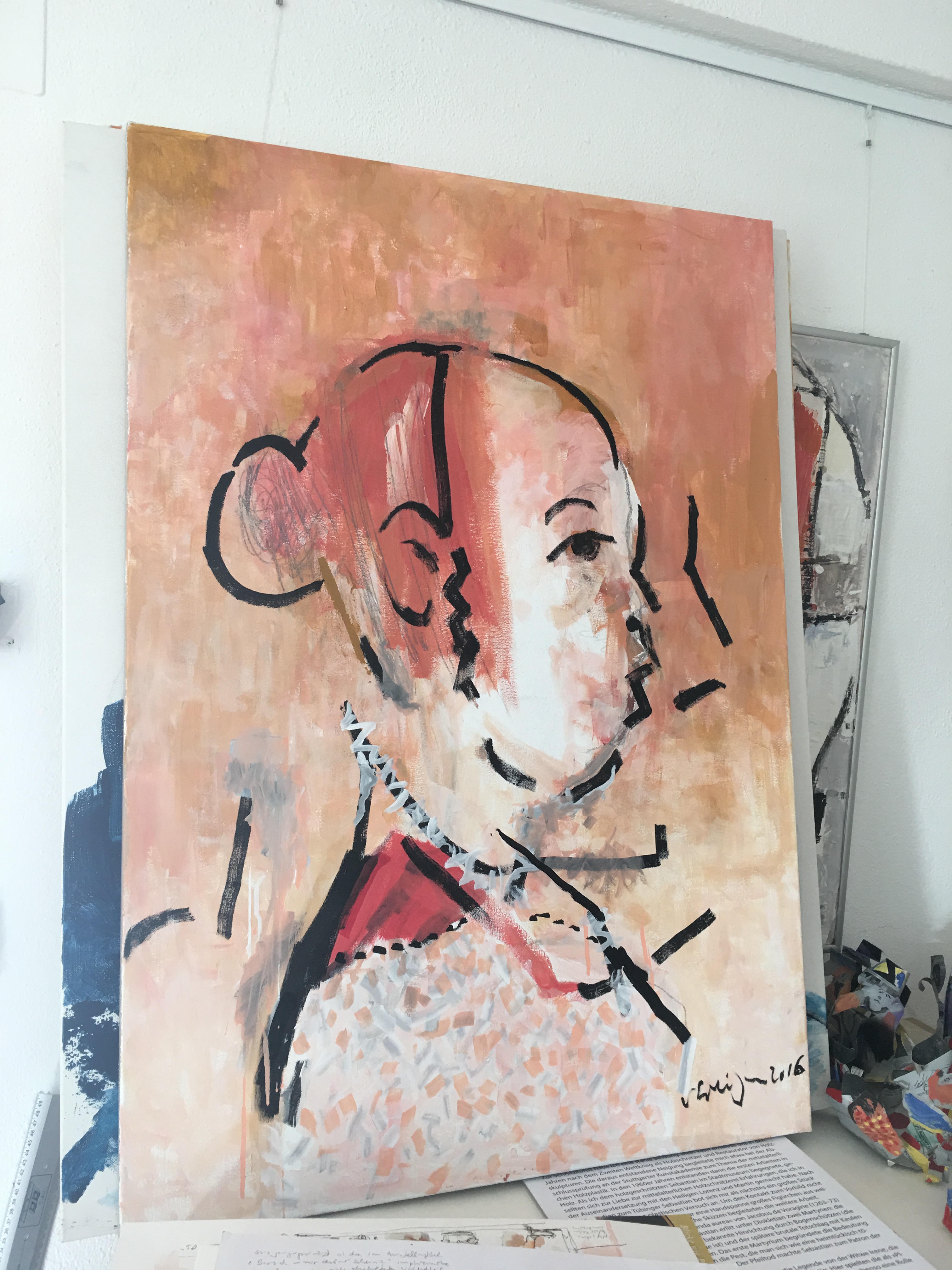
… but I sometimes share the desperate desire to sign the world, to make it my world! Then I draw black lines over a color-photograph,cover things with a colorful carpet and special letters or even make them to construction- elements of new objects. And it happens that I ‚destroy‘ this way one of my paintings, that I can’t stand any more. There is a joyfull obsession of writing in a very personal way ‚beyond‘ letters; an energy of giving things structures and rhythm and a certain ‚horror vacui‘, a drive to cover surfaces, to give unnamed things names and meaning. I („it grew“) developed over the years a repertory of signs in continuous variations and a practice of employing it for a variety of purposes. ‚Texts‘ that make happy, courageous, adventurous, but also texts that tell of the fear to be left …
Believe it or not:What looks like kids drawing is a ‚result‘ of decades of art activities. Here some, perhaps familiar, keywords of what happens in such a long life span:
1950-1959 typical school art striving towards naturalism. In the later teenage selfexpression and experiences with modern art.
1960-1970 trying to find in various studies and institutes the own place in the world of art
1970-1980 breakthrough of political reflections: the arts in a cruel world
1980-90 what is the real job of your personal art: illustration, independant work or match of historic art and own art?
1990- way back to the genuine elements of art–but not l’art pour l’art. A way to personal and relaxed art.
It seems as if Picasso’s saying that he started as Raffael and endet as a child, happened to be paradigmatic for our generation, but I wonder whether younger artists share this view today.
Reading on facebook about the birthday of my „analogue “ friend Peter Prange, I remember a very exciting experience we both shared. During a walk in spring 2009 he told me about Garcia Mendez, a portuguese woman who became one of the most remarkable personalities of the jewish world in the 16th century. In a certain moment I asked him what he thought of illustrated books. He was horrified. Since I had published one of my better books „Vom Text zum Bild“ (Deutscher Studienverlag, 1996),to this subject, we went on discussing this issue for 1 km or so. Then I offered spontaneously to perform pictures without knowing the book already. After months it were about 40 drawings in pen and ink on handmade paper each 70×50 cm,exclusively dealing with Garcia Mendez. When the book was presented (P.P. „Die Gottessucherin“.Kroemer-Knaur, 2009)
the first time, we showed the drawings in the same room. A nice lady from the publishing house produced a so called live book. Peter wrote wonderful notes to every picture. You can still find it as „Die Gesichter der Garcia Mendez“ under www.droemer-knaur. de>livebook. More of the designs and the story of our „march“ you find in my book „Meine Bilder“. Ernst Wasmuth, 2009.
Eventually sunshine today! I decided to take pictures of two sculptures that you may have seen posted already before. Actually I wasn’t in my very best shape. After struggling with facebook and a legion of friends or so called friends I was troubled by the feeling of getting somehow rid of my identity. Though there were some attraktive ladies asking for friendship. Flattering isn’t it? But after a while I realized that their ideas of art were not exactly mine. But right now it happened. My sculptures appeared in the bright light of the sun on the display of my i phone so beautiful, that I immediately fell in love with them. Amused I had to think of the ancient sculptor Pygmalion who went crazy about the marble -lady he had just created. So that’s what old Ovid told us in his ‚ars amatoria‘. Ok, in my case it was not a female beauty and I needed even a camera to become aware of the beauty- but anyhow! Once in this romantic mood I had to think of another famous myth: When Narcyssus saw his image on the surface of a lake, he was lost in self-love. The same happend to me when I looked at the camera-display. And I felt really good. Narcissism seems to be an emotional base for an artist. Don’t you think so? But maybe you are less vain than I am…
Can you imagine how it feels when your familiar world turns upside down? That happened to me when I read a book about the Silicon Valley (Christoph Keese, Silicon Valley, München 2014) . I realised that my continuous efforts to bring art and reality together, were more or less a search for the grail. I had missed the crucial insight that artis reality. The impulse for this knowledge came from the word „exponentional“ . I had never heard before that exponenti0nal processing and changes are the base of the digital world. Instead of a linear change, information spreads in all dimensions. Understanding this more or less, I realized that my passion for rasters , grids and structures( see figures below, starting with a page from a study report ,1962) has to do with this model. That art generally is in a way exponentional. Every dot, every line reaches out to reality and shapes reality. What disturbs me is, that it took such a long time to understand this :You probably don’t know that the title of the first book I published was „Struktur und Politik. Grenzwerte der Kunstpädagogik.“ (Berlin 1975).
Study report 1962
Spacial characters
Motion pictures
Cut out
Collage on black carton
WWatercolours and Collage
Shortly after finishing the Silicon Valley- book I experienced a second epiphany. My daughter gave me a small yellow book by the artist and author Austin Kleon, titled „Show your work!“ He encourages artists to blog and show there works and working processes as often as possible. For me was it the call to communicate my art experiences in a new way, not in books, papers and essays;but in a playful, light manner, far off from academic doctrins. More suitable to that what I practise as an artist and achieved occasionally as writer. So I started blogging with the help of my oldest grandson Ben. Thank you Ben!
Some of my former,more „playful“ writings:
50″Briefe aus der Ästhetischen Provinz“ , in:BDK-Mitteilungen 1988-2000
„…und er ist nur ganz Mensch,wo er spielt.‘ Zu Schillers fröhlicher Regression in den ‚Avanturen des neuen Telemach.“ In : B.Wichelhaus (Hg), Kunsttheorie,Kunstpsyhologie, Kunsttherapie, Berlin 1993
“ Ferdinand Hartmann, Hans Heinrich Meyer der Geheimrat Goethe und wir. Anmerkungen zu den Weimarer Preisaufgaben.“ In: Schiementz/ Beilharz(Hg). Ins Bild gesetzt. Weinheim 1995
Das war Buri. Bilder aus einem vergessenen Leben; mit 21 Federzeichnungen, Tübingen: Heliopolis 1990




 There are two major ways to deal with objects: either contemplating or acting. As an artist I suffer from a drive to move things, change their look, to copy and transform them in diffferent materials with various techniques, to deconstruct and analyze them. I remember the very first meeting of our illustration class some fifty years ago. We had to choose one of the objects being around and draw it. I didn’t really like this job. I decidet to take Photos of an antique head. I worked in black and white from any possible angle and in various lightings trying hard to bring this white mass to life, to animate it. The word Animation from the latin ‚anima‘, soul, matches this passion perfectly, because it comes deep from my heart and soul.