17) In between

img_2641
„You don’t have to hide, we know who you are!“

Just a word…

Already as a teenager art was very important for my way of life. After frustrating art studies (nobody asked what art is and what it would be good for…), I studied iconology and regained my selfconfidence. So it was natural to combine iconology and art. Creative actions became equivalent with discurses and arguments. My drive is to enhance our cultural education based on history and philosophy when we make „creative experiences “ (Vittorio Gallese). We have to find out what the aesthetic part of our life contributes to humanity.

Auf ein Wort 

Schon der Teenager erlebte Kunst als sehr wichtig für sein Leben. Nach frustrierendem Kunststudium (niemand fragte was Kunst sei und wofür sie gut wäre), folgte ein Studium der Ikonologie. Das gab die jugendliche Gewissheit zurück. So war es natürlich Ikonologie und Kunst zu kombinieren. Kreative Aktivitäten wurden mit Diskursen und Argumenten gleich gestellt. Mein Ziel ist es, unsere kulturelle Bildung auf der Grundlage von Geschichte und Philosophie durch „kreative Erfahrung „(Vittorio Gallese) zu verbessern. Wir müssen herausfinden, wie der ästhetische Anteil dazu beiträgt das Leben menschlicher zu gestalten. Blogging scheint geeignet zum Schritt-für-Schritt Forschen und gibt Lesern und Autor in jedem Augenblick die Möglichkeit zu interagieren.

16) Art heals

img_2605 After an operation at the open heart I had the chance to recover in a rehabilitation clinic. There I realized how close art and life would be to me. I had taken a watercolor block, pencil and watercolors. Every day a picture arose. Even in a small selection of six pictures (out of twentyfour), the process of recovery is quite good to observe.
Nr 1

Enter a caption


img_2612
Nr.2


img_2601
Nr.5

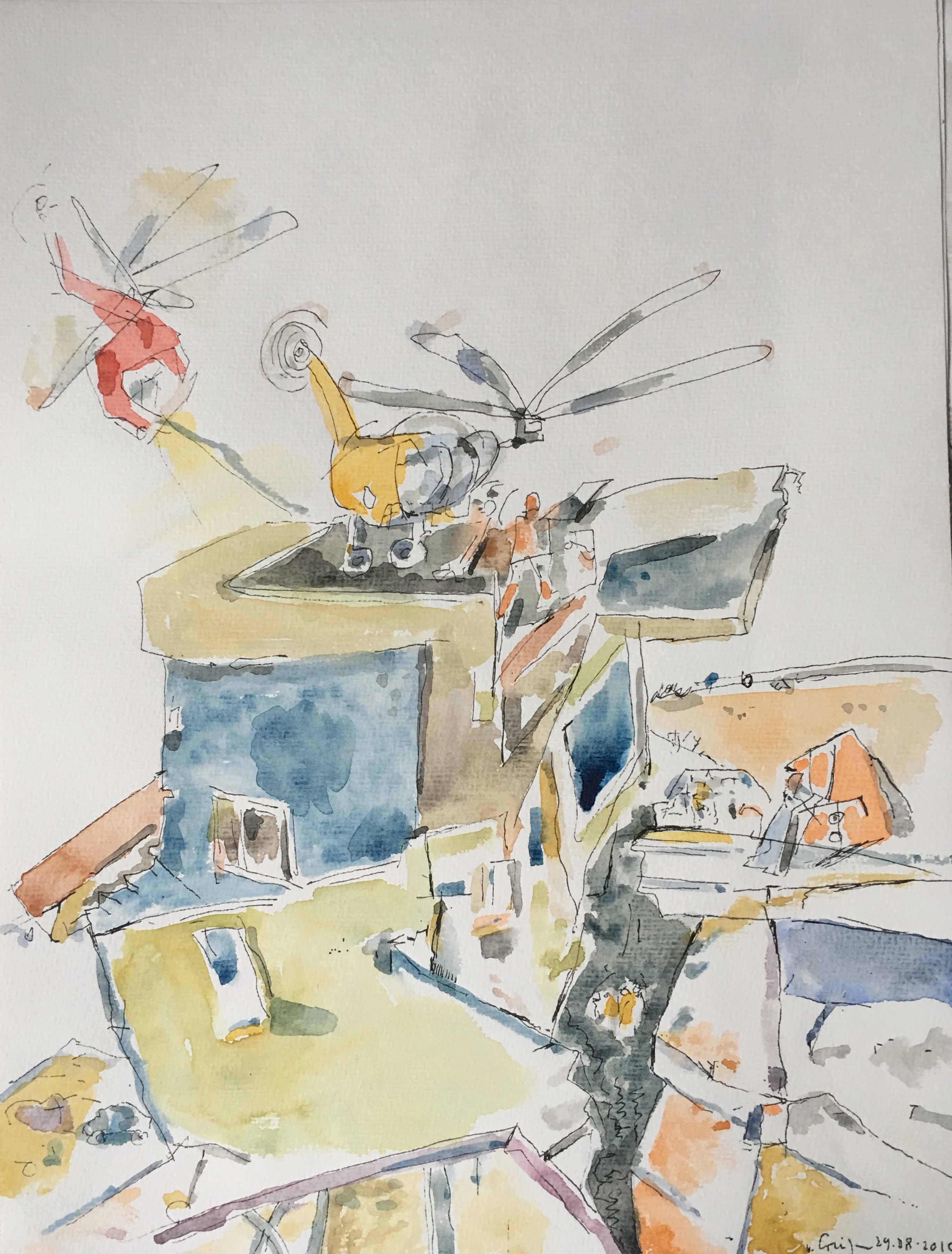
Nr.2:A week later a memory of the clinic is urging in the drawing. From my room I had been able to watch the take offs and landings of helicopters on the clinic roof day and night. To see these gigantic insects on the building, which was built  with a lot of glass and metal, was exciting. I had no interest to capture the spooky nightly situations. I was rather concerned about the bizarre and unstable nature of architecture and flight device. It was the first picture which in a playful manner refers directly to the hospital stay.

(Nr.3:)The picture of the next day shows how deep such woundings really reach: a man , incapable of any movement in a spindle press, stares in the eyes of a bizarre creature. The pale meat red also has an opressive effect.

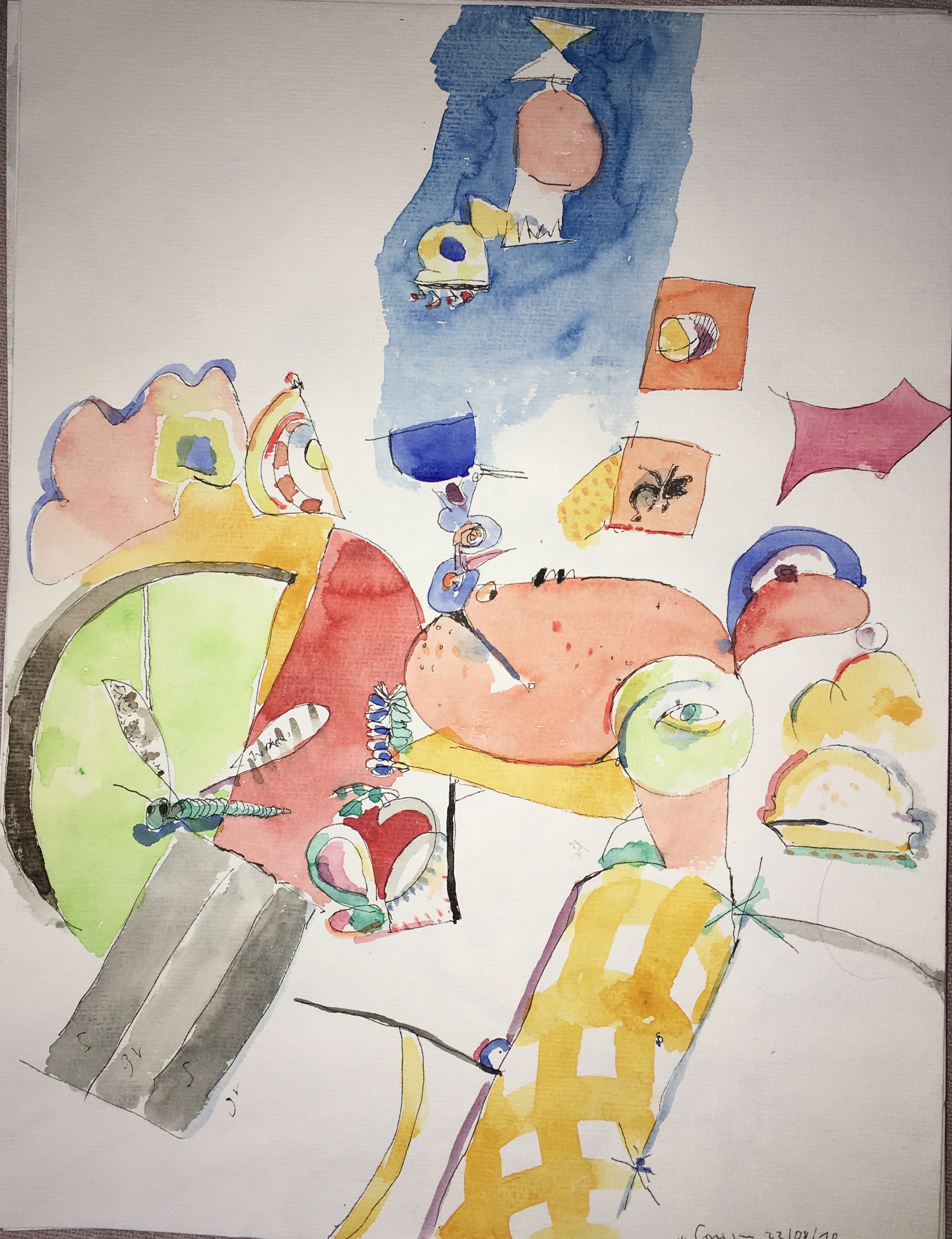
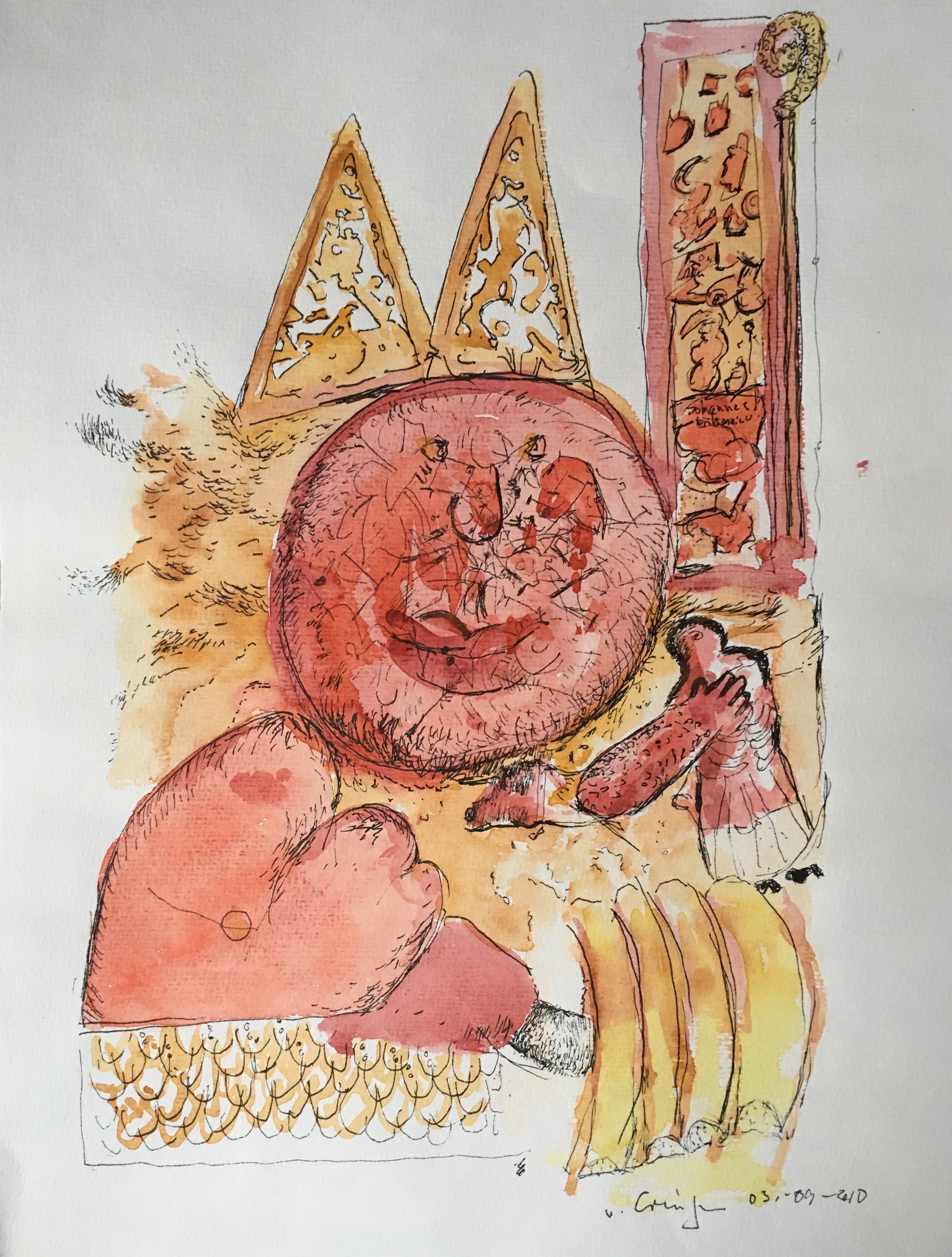
(Nr.4:)Four days later the insignia of a bishop- mitra and cripple- appear. I had studied St. Martin of Tours before and many pictures and sculptures had already been created. But I still had problems with this man (see post“ The goose bishop of Tours“). So it came that this figure „sneaked“ in the picture. Dominant are other elements, the central red moon face, the big heart, the stele. Below this an arm holds a figure whose ribs can be seen as in a radiograph. The four broken, banana-yellow ribs match this subject. You can imagine that the ribs are treated  very roughly in open heart surgery.

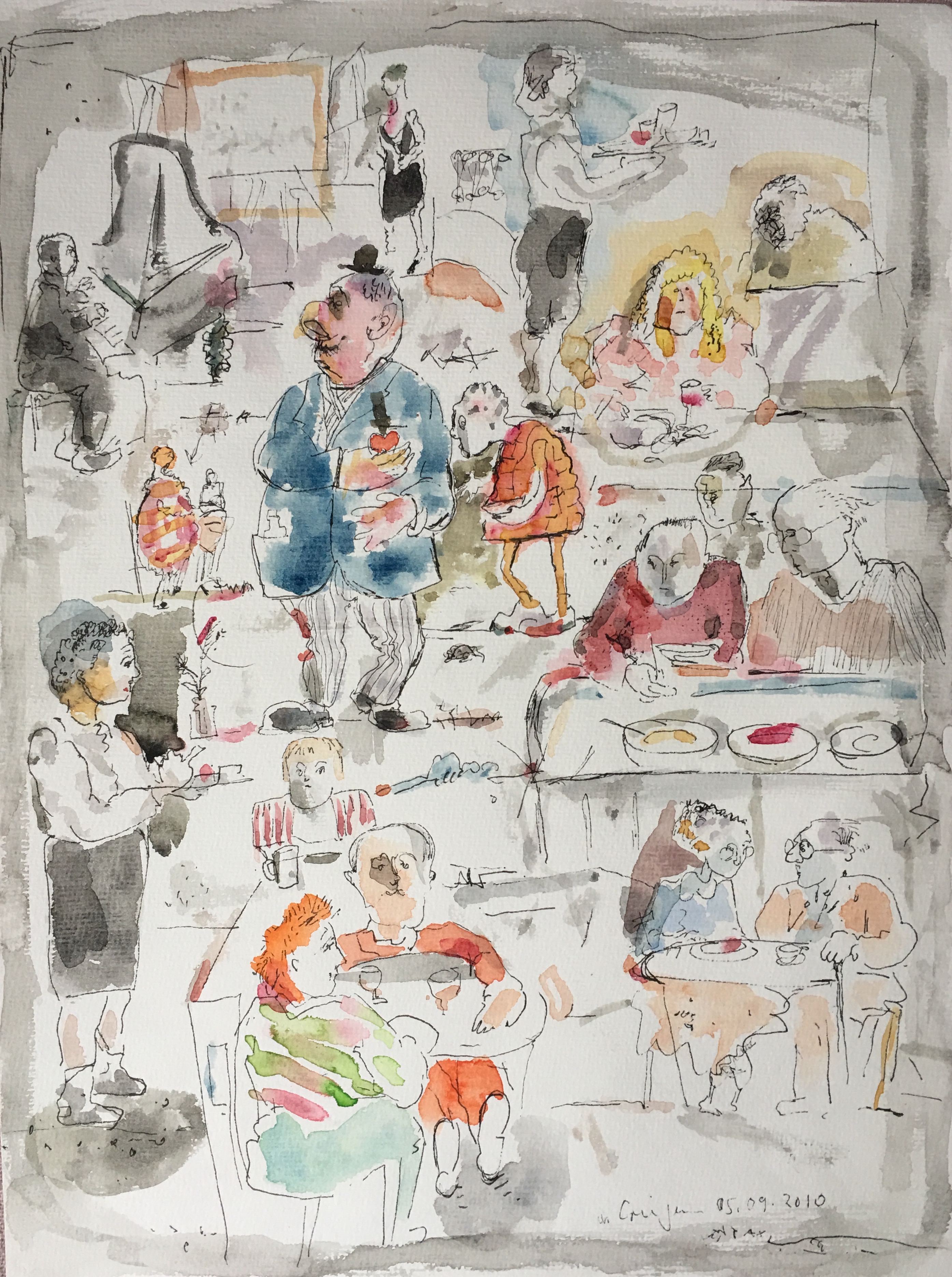
Nr.5:An obvious part of my reality were the fellow eaters. Fore three days in a row they were my subjects. They were the important step „outside“. In the first of these pictures a pianist, who had enriched the previous evening, can be seen in the upper left corner. I have presented myself as a clown, who tries to keep his heart, on which a large arrow points.

Nr.6:img_2594

In the morning when I was dismissed, a last picture arose on which the heart seems to hover out of a world full of cheerful creatures. Now everything goes together: the successful operation, the joy of the world and its diversity, the pleasure to tell stories, the growing self-confidence, the feeling of security and ultimately the confidence in the power of the images.

15) St.Sebastian

When I had the chance to study a la late gothic wood sculpture in the nearby city museum of Tübingen, I was struck by its expression and craft. The artist is unknown but the style is that from about 1500 in Southern Germany. It represents St. Sebastian without the familiar arrows, only some small holes show where they originally stuck.

I ‚ answered‘ to this awesome work in my way. The first approach was a 160cm high statue cut and bent from a large, rusty copper sheet. With drawings and watercolors I tried to get closer to a solution. Most of my time was spent to carve a  sculpture from a 170 cm long, hundreds of years old oak beam.

There is one issue I remember particularly. I wanted the lower part of my sculpture somehow correspond to the pleats of the gothic original. I tried two small hooks or volutes, but they looked like bones of a soup chicken. They were removed. Maybe it had to do with the extremely slender proportion of the oak beam, that there seemed to be two human bodies. This was no problem because Sebastian was tied to a tree, but it made a second meaning come up.

Guess why in the 20th century more essays, fotos, videos, films ,paintings were published than ever before ?  The answer is that after centuries of St. Sebastian as plague -saint, he was chosen by the gay community as patron. And that leads us back to the late gothic sculpture and 1500. Looking for a subject to study the ideal male body the italian renaissance- artists discovered St.Sebastian and gave him a new identity. This was the starting point for the mentioned modern worshipping.

see also Axel von Criegern, Mein Sebastian;in:Echo I. 13 Tübinger Künstler. Kunst im Dialog mit dem Stadrmuseum.2016.S. 6,7

14) Martin, the goose bishop of Tours

img_2547

For all those who are familiar with the history and legend of Saint Martin of Tours ( 316/17 -397) this sounds probably blasphemy. But this was not my intention when I decided to focus on a popular legend which came up in the Middle Ages. Martin was the first saint of the young christian church who was not a martyr. He was a humble and ascetic Jedus follower. He was none of the upper class clerics who ruled over the church after it had been declared the official cult of the Roman Empire under Constantin 333. The most famous  event of the Martin’s legend is the sheath division when Martin cut half of his officer’s coat and gave it to a poor, naked man shivering in the winter cold. It was Sulpicius Severus , a friend of biographer of Martin who reported this story. Over the centuries followed the artists the doctrine and showed Martin as a splendid knight, while the poor man became less important…

The story of the geese who revealed Martins hiding place when he refused to be bishop of Tours as the common people wished, is no issue of the biography and never became part of the Martin’s theology. Even Jacobus de Voragine didn’t mention it in the ‚legenda aurea ‚. The story reminds of the chattering geese of Rome, fables and fairytales. So why not tell a fairy tale following exactly the biography of Sulpicius Severus? Together with a friend who happened to be pastor of a Martin’s church I studied for more than one year sources and literature of all kinds to end at the geese‘ story. Transforming a saint in a goose was one challenge, another one was converting the biography into a fairy tale. At the end the goose bishop was born!

Axel von Criegern, Der Gänsebischof von Tours, o.J. Tübingen (Gulde).

Axel von Criegern, Meine Bilder, Wasmuth 2009.

Cless& Axel von Criegern: „Bischof Martin von Tours. Ein theologisch-künstlerischer Dialog.“ In: Danner, Gansen,Heyd,Lieber (Hg), Ästhetische Bildung. Perspektiven aus Theorie, Praxis, Kunst und Forschung. BoD-Verlag 2011.

Sulpicius Severus, Leben des heligen Martin; Vita Sancti Martini,; Lateinisch und Deutsch, herausgegeben von Kurt Smolack, Sankt Martins Verlag 1997.

Jacobus de Voragine, Legenda Aurea. Aus dem lateinischen übersetzt von Richard Benz, Heidelberg 1984 (ca.1270).

Wolfgang Urban, Der heilige Martin; Sadifa Media Verlags-GmbH,Kehl 2013

13) Halloween-Allerheiligen

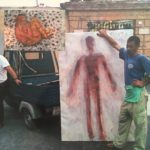
  • At Halloween I received a message from my son: Saturday at 20:15 would be a TV-broadcast about „my“ Saint Martin. Indeed have I done a lot of studies on this saint. But it was not the only one. The first was Santus Laurentius, San Lorenzo, Saint Lawrence or Hl. Lorenz. Below you see some pictures from a show „Il sorriso di S.Lorenzo“,that I had in Italy 2009.


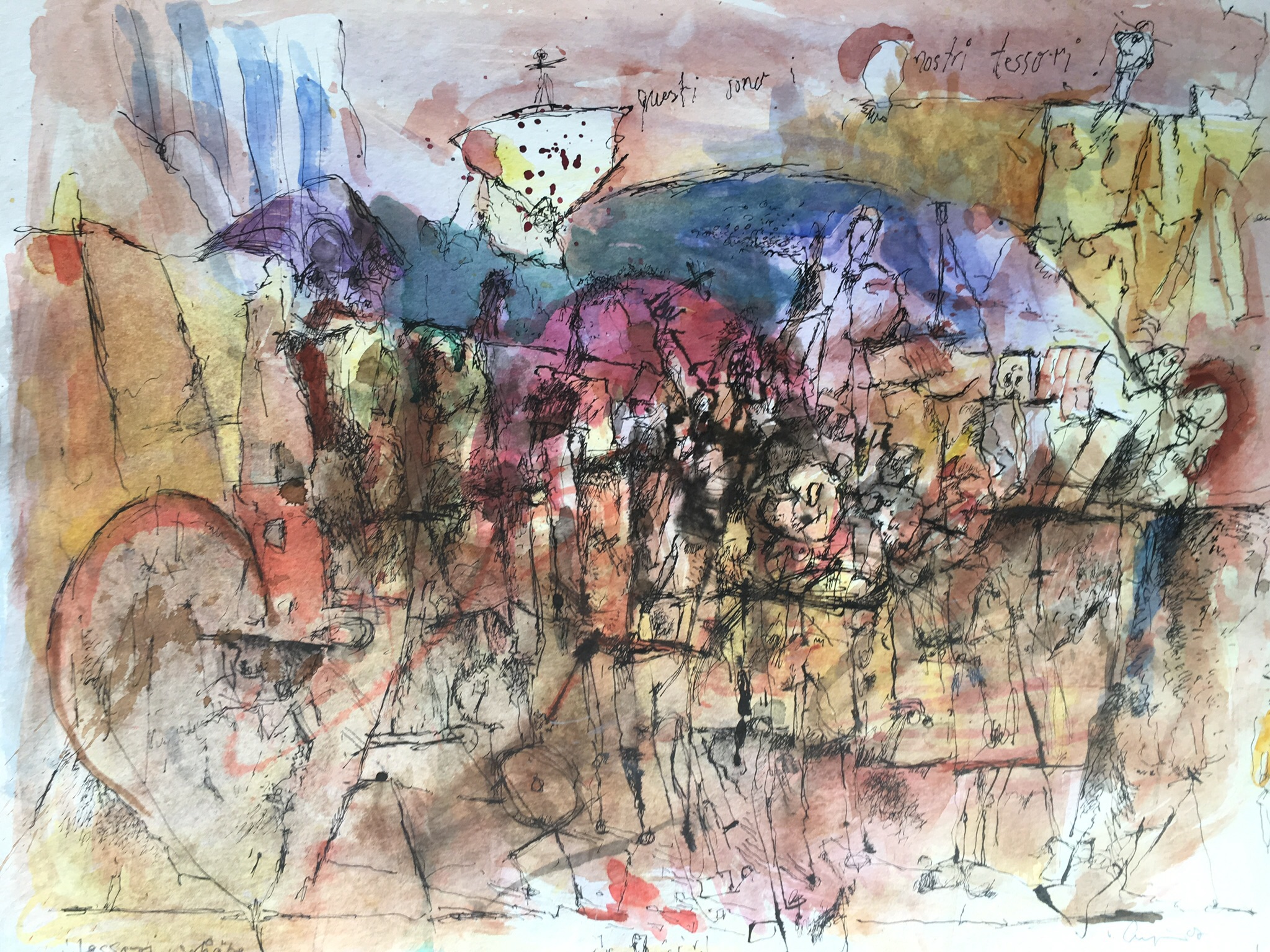
2007 the priest (parocco) of the italian village, where I stay every year for some weeks, asked me whether I would like to show some of my watercolours in a desacrated church. It is an awesome, wounderful baroque building called after its patron S. Lorenzo. After a first visit I decided not to show landscapes and other „watercolours“, but to do something about this saint. He lived in the tird century under the emperor Valerianus in Rome,  and was treasurer of pope Sixtus II . When Sixtus was murdered the emperor gave order to deliver the church property to him, which Laurentius denied. He was condamned to a cruel martyr becoming roasted on a grid.  The grid became the attribute of the later saint. Of course bloomed a lot of legends around his death. For example: The order of the emporer to deliver the church property answered Lawrence giving all the money to the members of the christian community and than, asked where the money was left, pointed at the people saying „this is our treasure“. An amazing, incredible story is that Laurentius was laughing and inciting the men to heat the fire more and turn him so that the roast would be well done.

While the former artists had to follow the official iconography  of the catholic church showing Lawrence suffering on the grill or standing with the grill as attribute, modern art concepts offer an almost unlimited scale of interpretations and presentations. As a straight follower of Aby Warburg and Erwin Panofsky I learned to appreciate the legends, pictures, texts and historical notions corresponding to the saints as important components of our culture. And I consider it my task to enlarge this „treasure“.

image

imageBy the way- my studies on Saint Martin will be subject of the next post. Promised!
(For more see: Meine Bilder, Wasmuth,2009)

12) 1968

img_2248
1968


1972


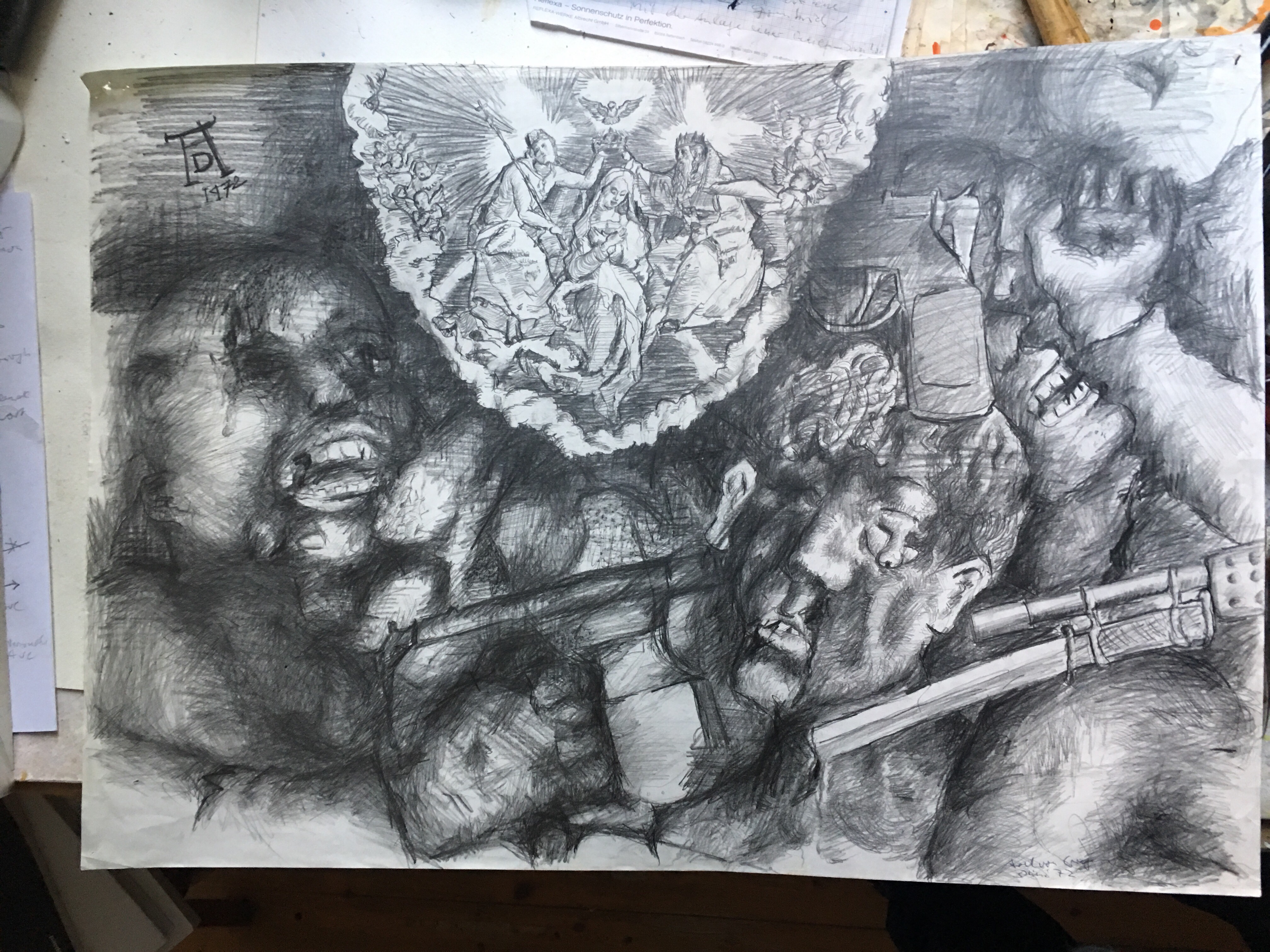
A museums lady asked for some leftovers or relics of ‚ 68. Sure these were the most ecciting times in my life. But relics? More or less gone. I checked my portfolios with works   on paper. The only one dated 1968 is a harmless design on a  cake paper.  Nice, but it doesn’t stand for our  vibrations in a  historical thrill. It is only a weak reflex of the art-revolution of this year. I experimented with scrap metal, glass fibre and styrofoam. None of the results has overcome. Most of my designs of the early seventies refer to social political criticism, but in an incredible naive way. Hard to  believe particularly because I studied some political science before. The only acceptable from this ‚political‘ works is a pencil drawing dated 1972. In the larger part it refers probably to the all over present vietnam war. In the upper central part you can seee a cut out of Albrecht Dürer’s „Coronation of Mary“. Maybe this seems odd to you. But it is a true document of the view a young art teacher, art historian and artist had of a terribly torn world.

11) Its really hard to assess ones own artistic performance


2015 I painted in 2-3 days a series of four pictures with acrylic paint on canvas; three of them 70×50 cm, one 60x50cm (with the black figures at the left). My wife hang three of them in our livingroom, the fourth with its wild darkgreen brushstrokes on ochre and crimson didn’t pass the jury.Immediately after finishing the series the one with the big rose-pink cube („chicu’s house“) was my favorite. When hanging on the wall,visitors and friends favoured the one  with the stairs and the door in the center. With some imagination you can see at the left in the gray, red and rose dots a big wisteria ( glycine). This was the last of the series and it seemed to me rough and not really finished. Now as time goes by I begin to like it too. And the fourth one? It is forgotten before its history could begin…

My iphone camera became part of my brain

img_2207img_0468

When I wrote ‚ Art is everywhere ‚ I focussed on our attention. I did not think about the part visual media play. This blog makes me experience my iphone camera as an extended brain function.

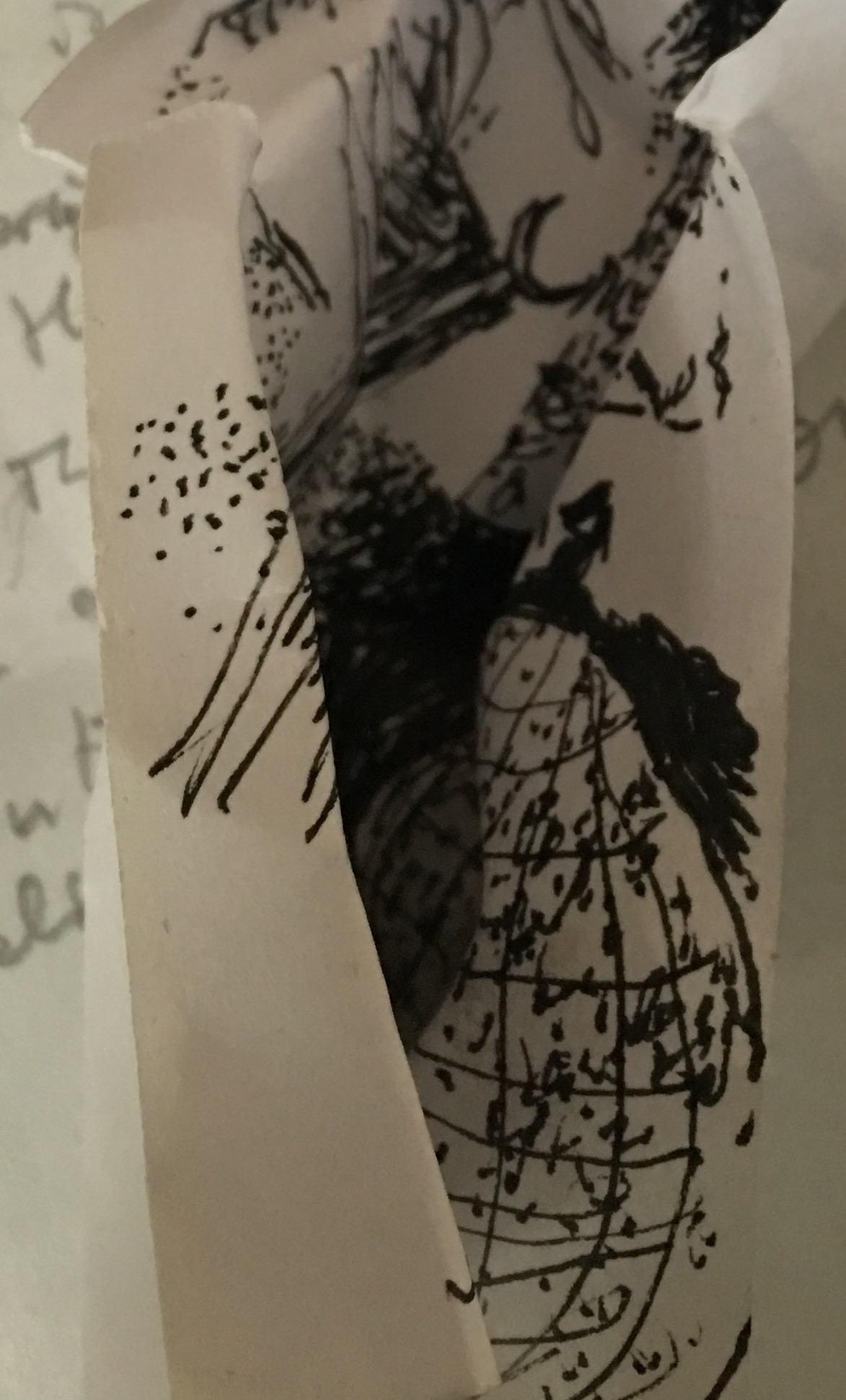
Example one:  watching tv I doodled on a paper strip, simply let mind and pen float. A few minutes later I decided to throw it in the waste paper bin. A second glimpse at the now already wrinkled paper made it attractive as a random product. And a final look through the iPhone camera added a completely new quality transforming it into a media object.

Example two : next day my wife pushed me to make up my wardrobe and buy a pair of pants. Strolling through the fashion shop I met those beauties without abdomen but graceful gestures. Pressing the button was like casting for a surrealistic art soap! Here they are: the models of our female beauty philosophy.