I want to tell a little story. During the cold weather period I can continue my wood work in a near glass shop. The shop-holders wife passes there several times a day and wonders what the result of my carving would be. She does not really accept my refuses: “ I see a little bear, yes this is something like a 🐻! “ Of course do I watch how forms become organically without my intention.But until the last minute I want to give the wood a chance to „express itself „. We all know and appreciate the high quality of traditional japanese, chinese, african art; we are impressed by the early egyptian , stone age, migration time or the art of the european ‚ dark Middle Ages ‚. But those artists were craftsmen in ritual duties, they didn’t know the free individual esthetic choice we have today. Quality was to match tradition, general expectations and the taste of the costumer. Today we create our own quality standards as part of our artistic production. So if my neighbor asks for similarities does she follow a natural impulse to define the unknown and give it a place in an unsteady, nostalgic world. And it’s not easy to explain why similarity is only a secondary quality – if at all. Now you see why I beware of similarities. I want to be authentic and follow my own quality standards.
Wir sind so konditioniert, dass wir unsere Welt erkennen und den Dingen Namen geben. Natürlich gilt das auch für künstlerische Gegenstände, bloß ist das nicht immer erwünscht. In meinem Fall stören gegenständliche Assoziationen, weil im Zentrum meiner Holzarbeiten der Dialog mit dem Material steht.
Sometimes re-reading the heroes of study- times is surprising. The word “ Einfühlung“ (empathy) hit me this grey december morning when I paged through Wilhelm Worringer’s “ Abstraktion und Einfühlung“ from 1907. In my study years Worringer wasn’t our first choice. But right now with my intention to investigate art practice and its impact on everyday experience his thesis becomes suddenly important. The basic idea is, that if you look empathic on a human being, animal, landscape, you increase not only your knowledge about people, nature or object, but also about yourself. Alright, this grey morning I looked through some older pictures without any particular interest, when one of the paintings caught my eys. It is probably 15-20 years old. I remember the style. In this very moment it was as if the sun broke through the haze. Colors, vitality and narrative began to light my melancholy and made me come return to this bright and amazing world.
‚ Einfühlung ‚ in ein früheres Bild kann zu einer veränderten Sichtweise und Stimmung führen. Hier half sie bei der Überwindung einer sich gerade festsetzenden Melancholie.
Alublech- und Acrylfarbe, 2016Alublech- und Acrylfarbe, 2016
My motivation to cut angels out of metal sheets was not really spiritual. It came from my lovely but not angel like wife, mentioning „why don’t you…?“ Ok, I did .After a while I liked it to cut metal in a way we know from clothes making; after that I played with colors, designs, robes, wings, body shapes, hairstyles.. To combine a very simple cut with decorative elements was my contribution to the world of angels, their spiritual and real existence. Angels are a product of religious and artistic culture. Can you imagine mediaeval religiosity and art without angels and can you imagine angels without the knowledge of Simone Martini, Fra Angelico, Jan van Eyck, Matthias Grünewald a. o.?
A bad day / ein schlechter TagA good day / ein guter TagBlockadeA good day / ein guter Tag
Yesterday I felt horrible. Practicing a kind of meditation I spread my familiar letters over the paper: boring! Today I felt much better, my spirits were rising, optimism and courage returned. Now I could do things relaxed and didn’t care about aesthetic correctness. In the afternoon I worked with my mahogany -block and decided to do a hard cut. The days before I didn’t even know how to go on. This observation can certainly not be generalized. There were also days when, although I had caught a cold, I painted concentrated- certainly not very inspired. And there were days when I felt overboarding energy – and produced rubbish. And seriously: do we see whether a painting was done while the artist suffered from terrible headaches? No, there is no pity for the artists, there is only good or bad art.
Ich hab mich an zwei Tagen beobachtet; einem vergrippten und dem darauf folgenden Tag der Besserung. Fazit: Es gibt kein Mitleid mit den Künstlern, nur gute und schlechte Kunst.
Metamorphosis as a term is important for natural sciences. We all know Metamorphosis in mythology. Even if we don’t use it as term the phenomenon is familiar in art. Just think about the ice age, the cave painting and carving of bones as f.e. the ‚Löwenmensch‘. In our Middle Ages are creatures as a mix of man and beast everywhere. A real cut came with the print media and the flyers. So became metamorphosis a basic element of the comic strip.
The metamorphosis has a magic attraction for artists. And I love it. A few days ago I discovered a booklet that I designed and wrote 1990: ‚Das war Buri. Bilder aus einem vergessenen Leben.‘ Tübingen 1990.ISBN 3-87324-088-2
The dutch painter Jan Steen (1626-79) is and was popular for his sense of humor based on studies of everyday life („genre painting „) and literature. At his time a young lady with red stockings was a whore.
Maybe I made something wrong, but fact is that only a rest of my original post was published. So I decided to write a short note on the original content. The young „iron lady“ above, cut and folded from zinc and painted with lacquer comes from a painting of Jan Steen. On my homepage you find more about my long art historical and artistic research on the merry companies of „my“ painter.
Any active person knows tha: while doing a job relaxed and tense situations change. Chiseling or carving are particularly tense, because they are one way roads. You can only remove but not add wood or stone. But there is another real hot spot when and where your inner form compass clashes into the characteristics of the material. You want to follow your intuition and realize than that a chunk of mahogoney comes from a beastly part of the tree, as there are roots, crossing branches, putrefaction. The wood doesn’t accept and doesn’t agree with your vision. Time for a tolerable compromise. There is a second genuine hot spot when you get close to realism. I call it the naturalistic trap, because you begin to feel a drift, that tears you to simulate reality. You feel that there’s something wrong, a violation of the good form. A naturalist sculpture is only good when things go together: features may look likely natural, but they don’t give up their very special language,have an aesthetic message.
And there is a third point: if you can’t and won’t compromise and nobody understands you. Comfort yourself and think of the legion of geniuses, who weren’t understood either!
Jede, jeder, der etwas macht kennt entspannte und angespannte Momente. Beim meißeln und schnitzen ist das durchgängig so, weil es eine Einbahnstraße ist. Du kannst nur Material wegnehmen. Ein besonders gespannter Moment ist es, wenn die inneren Formvorstellungen auf die Eigenarten des Materials stoßen. Du möchtest deiner Intuition folgen, aber das Material spielt nicht mit. Zeit für einen Kompromiss. Und dann noch der gefährliche Naturalismus. Die plastische Sprache muss stimmen ! Und wenn deine Arbeit niemandem gefällt, tröste dich mit den tausenden Genies vor dir, die auch nicht verstanden wurden.
Already as a teenager art was very important for my way of life. After frustrating art studies (nobody asked what art is and what it would be good for…), I studied iconology and regained my selfconfidence. So it was natural to combine iconology and art. Creative actions became equivalent with discurses and arguments. My drive is to enhance our cultural education based on history and philosophy when we make „creative experiences “ (Vittorio Gallese). We have to find out what the aesthetic part of our life contributes to humanity.
Auf ein Wort
Schon der Teenager erlebte Kunst als sehr wichtig für sein Leben. Nach frustrierendem Kunststudium (niemand fragte was Kunst sei und wofür sie gut wäre), folgte ein Studium der Ikonologie. Das gab die jugendliche Gewissheit zurück. So war es natürlich Ikonologie und Kunst zu kombinieren. Kreative Aktivitäten wurden mit Diskursen und Argumenten gleich gestellt. Mein Ziel ist es, unsere kulturelle Bildung auf der Grundlage von Geschichte und Philosophie durch „kreative Erfahrung „(Vittorio Gallese) zu verbessern. Wir müssen herausfinden, wie der ästhetische Anteil dazu beiträgt das Leben menschlicher zu gestalten. Blogging scheint geeignet zum Schritt-für-Schritt Forschen und gibt Lesern und Autor in jedem Augenblick die Möglichkeit zu interagieren.


 Sometimes re-reading the heroes of study- times is surprising. The word “ Einfühlung“ (empathy) hit me this grey december morning when I paged through Wilhelm Worringer’s “ Abstraktion und Einfühlung“ from 1907. In my study years Worringer wasn’t our first choice. But right now with my intention to investigate art practice and its impact on everyday experience his thesis becomes suddenly important. The basic idea is, that if you look empathic on a human being, animal, landscape, you increase not only your knowledge about people, nature or object, but also about yourself. Alright, this grey morning I looked through some older pictures without any particular interest, when one of the paintings caught my eys. It is probably 15-20 years old. I remember the style. In this very moment it was as if the sun broke through the haze. Colors, vitality and narrative began to light my melancholy and made me come return to this bright and amazing world.


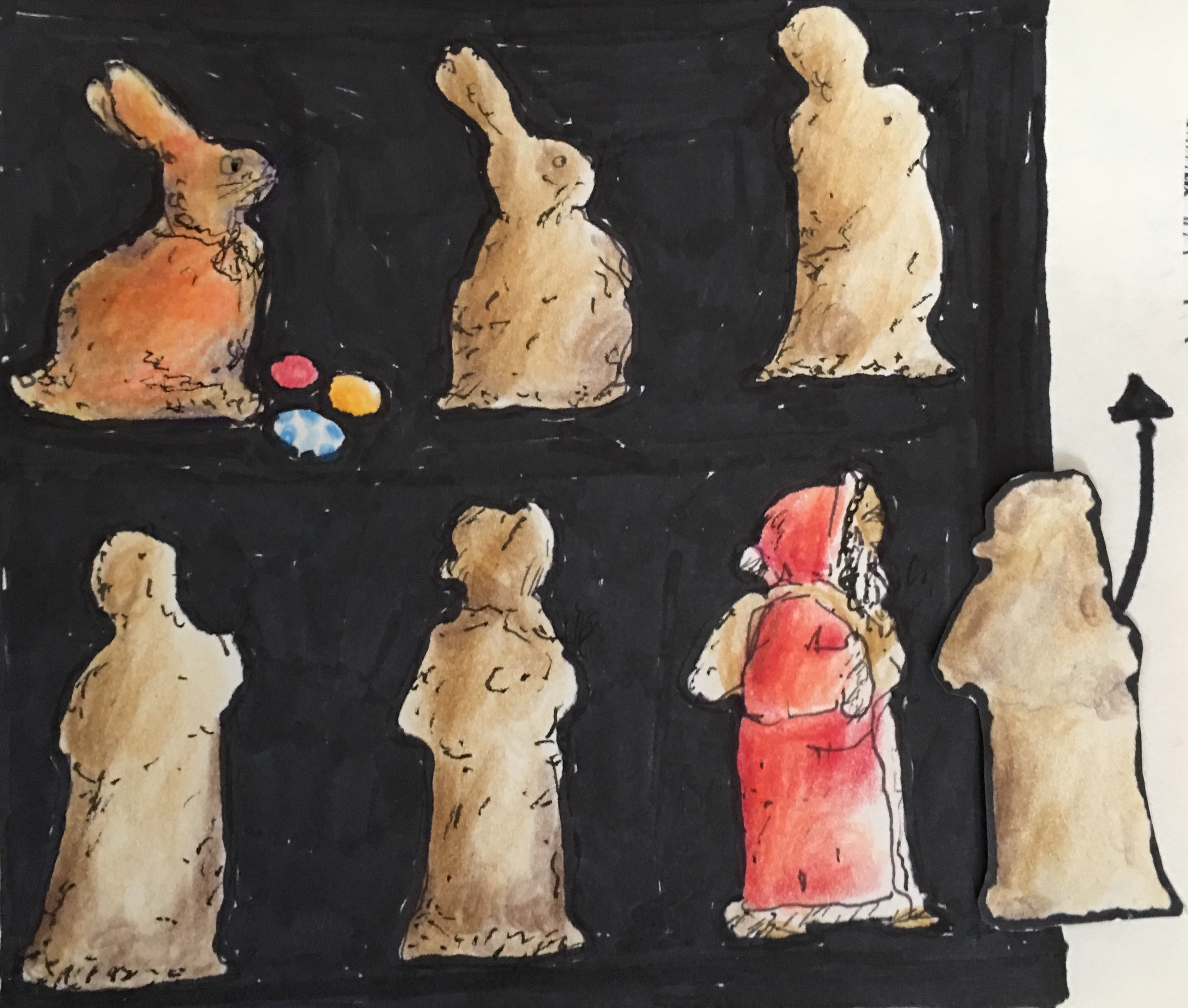 Metamorphosis as a term is important for natural sciences. We all know Metamorphosis in mythology. Even if we don’t use it as term the phenomenon is familiar in art. Just think about the ice age, the cave painting and carving of bones as f.e. the ‚Löwenmensch‘. In our Middle Ages are creatures as a mix of man and beast everywhere. A real cut came with the print media and the flyers. So became metamorphosis a basic element of the comic strip.


The dutch painter Jan Steen (1626-79) is and was popular for his sense of humor based on studies of everyday life („genre painting „) and literature. At his time a young lady with red stockings was a whore.