Full moon

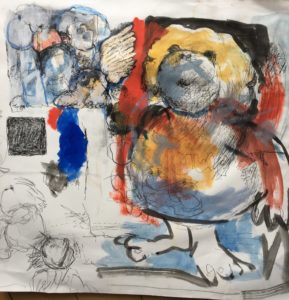
Saturday night was full moon. My wife shouted : “ Come and see!“ Ok! Ok! But the moment I saw the moon in fight with clouds passing the steeple of the nearby church, I was caught by this ‚motif‘. And of course does it make sense: I am not a farmer who is familiar with the importance of the moon periods for seeds and plants. And I know little about the goddess moon and her mythical, healing, haunting,or magic power. What I remember is a child staring at this shining plate and trying to figure out how the face of the man up there looks like. And what I know for sure is that the full moon was and is still a very romantic motif in painting, illustration and poetry in Europe. And I remember C.D. Friedrich, Spitzweg, Goethe, Blake, E.T. A. Hoffmann… It is hard not to see what you have been taught, isn’t it?

28) „As time goes by“

Designed with fingertips on an iPhone. The monotone picks give a sensation of passing time

Time is an issue that occupies my artistic imagination again and again. Not so much the traditional allegories of time, as what happens in modern art. The artists of the italian futurism invented a new design for ’speed ‚. It were the surrealists (Dali, Ernst, Magritte) who employed new dimensions of time for their art. Philosophy, psychology and language gained a before unknown importance for the visual art. Yesterday I had the chance to see a show at the Stuttgart art museum titled „(Un)erwartet-Die Kunst des Zufalls.“ A great concept, a great show- to say it in Trump speech. The blend of mathematical processes, cybernetics, aesthetics and play opens the view on new sensual  time perceptions. For a moment I realized how much a blog and its single posts can themselves be elements of aleatoric processes.

27) Now I definitely feel much better!

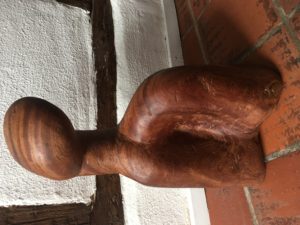
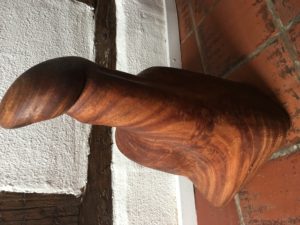
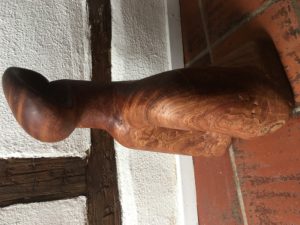
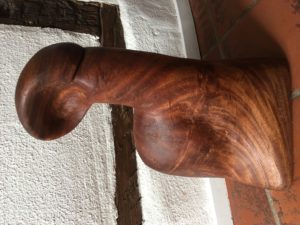
  1. In a former post („Beware of similarities!“) I had discussed a conflict of modern art. Our appreciation of a work is not based on natural similarities but on how it is done. I realize this physically when sculpturing. If there is once a similarity noticed by myself or somebody else it is like fighting an enemy.
  2. In this special case of a hard to handle mahogany block the significant grain played an important role. And here waits another trap: the grain should not be master of a wooden piece. Maybe that everybody will like it, but soon  you will realize that art slipped away.

Parallel worlds (6) and children

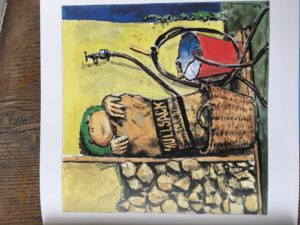
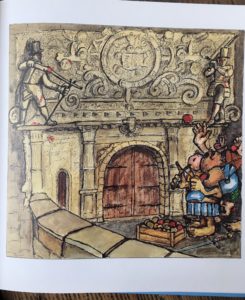
  1. To watch children playing and listen their stories is a pleasure  for most artists. Children are curious, they wonder, ask, look and talk frankly. If you want to reach them stories are the best.  You have to fascinate them. This is both, easy and difficult. They are simply different. It made me smile watching my 9 years old granddaughter, a really brilliant young lady talking seriously to her barbies. Is that the same girl that five minutes ago explained and demonstrated what a screenshot is?When I developed the idea for the „Tatort Tübingen oder das  gefährliche Leben des Wachtmeisters Glotz“ I wanted to tell the kids that ‚police ‚ means more than law and order. Maybe that my way seems to be strange, but they like it.
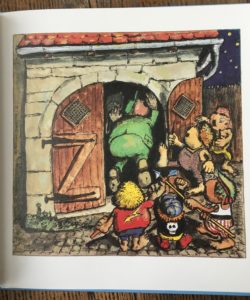
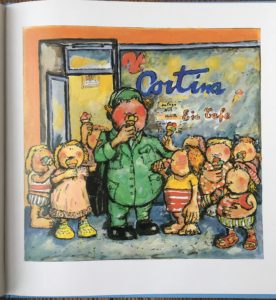
  2. The constable Glotz is horrified by an order that he has to do his job no longer on car, but walking through downtown. He has a terrible dream. A gang of young people is chasing him, playing evil pranks and doing forbidden things. When the torture comes to an end throwing him into a dark cave he wakes up .sweating and shivering.  But there is no  darkness and threat!  The sun is shining in his bedroom   and he hears the children in  the kindergarten laughing and chatting. At the end the brave policeman envites them all  to an icecream.
  3. That was 1987. But I never lost my  trust in the enlightenment! 
  4. Axel von  Criegern, Tatort Tübingen oder das gefährliche Leben des Wachtmeisters Glotz; Tübingen (Osiander), 1987

25) Parallel worlds (5): Loss of reality?!

If an artist creates a parallel world, she or he do experience what creation means. You have to invent  this new world. Errors are inevitable. You will realize that you are on a one way road and you may end with a hubris or mania. Symptoms of a mania will be if you can’t stop developing your private parallel world before including everything. I realized that when we studied fables in an  illustration research project. Immediately I started to transform Aesop fables into „Tuwo “ fables. Our vacations at the cote d‘ azure became Tuwo vacations. I even developed a concept for a Tuwo Research Institute . This sounds like an obsession and a loss of reference to reality. Certainly it is. But we should keep 😎, because creativity is inextricably bound up with dreams, imagination and fantasy , isn’t  it?!


Parallel worlds (4): Basics

The great story

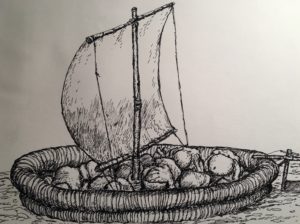
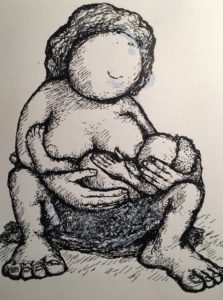
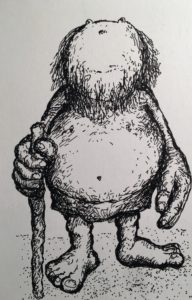
Maybe that we are the most  developed beings on the ‚ blue‘ planet. But we cannot think beyond our brains. So when we imagine parallel worlds we think human. And we need to think and feel very simple, archaic, because only this way parallel worlds are imaginable. And since I don’t want to imagine a hostile, abominable world, my parallel world is positive. Some issues are shown in the following pictures.

Devastating natural elements
The thrill of adventures
The circle of life
Community
Emotions
Encounters with the unknown
Pity
Age


Joy of life

Parallel worlds (3): Back to the roots

„Tuwo“; Travertin, Swabian Alb,/ Germany, about 30.000 B.C.
„Tuwo“; Flooded wood, Bergen/Norway, about 500 A.D.

What the Tuwos learned from this unpleasant experiences was to search for their origins and to reconstruct their history. They could identify very old and very enigmatic archaeological finds as Tuwos. Very clearly had their ancestors settled all around the world; discoveries that gave the Tuwos a history and made them very proud.

We are so much used to our system of history and art history, that we have difficulties to classify the art of any parallel world. But remember that our history of art is by no means plain and transparent: think about the thousands of years after the Stone Age or the migration period, periods of cultural darkness, iconoclasm, art prosecution for political, religious, economic, racial  reasons. We know little about the history of the Tuwos, but they certainly had and have their dark sides too; remains the hope, that they learn from our ‚ parallel world ‚.


Parallel worlds (2): Recognition

It is fascinating to watch the tuwos struggle for recognition by our world. It was a hard and long way to create what we call an identity. They must have suffered a lot from the lack of respect. First they tried the story of a tuwo waking up from a long dream facing a strange world. (s. Barbarossa in the mountain Kyffhäuser or Washington Irvings  „Rip van Wrinkle „). But they had to realize that this was just a story among others. The next approach was to behave more aggressively. They disturbed political meetings, messed around with banking, incited riots, offended moral, religious and cultural rites. Against their friendly nature they acted really disgusting. But that wasn’t what they wanted to be.   L

24) Parallel Worlds

This funny guy is born in the second half of the 1980 ies and belongs to the ‚ tuwos‘. The tuwos lived at this time on a small Pacific island. They are real pacifists and live in a perfect harmony with nature. There were only rare contacts with the inhabitants of a parallel world; and those were horrible!!…

Parallel worlds are not necessarily better worlds. Depending  from the image of universe and world there lived terrible creatures on the opposite side of the earth, the oceans or in the darkness. In the age of traveling and exploring those other worlds  became more real. I n the period of the world wars unknown powers-good and bad ones reached out to the real world, whether they were called ‚Super‘-‚Spider‘-or‘ Batman‘. And in our days parallel worlds may be other universes or production of our brain, more dangerous and horrifying than anything before.